


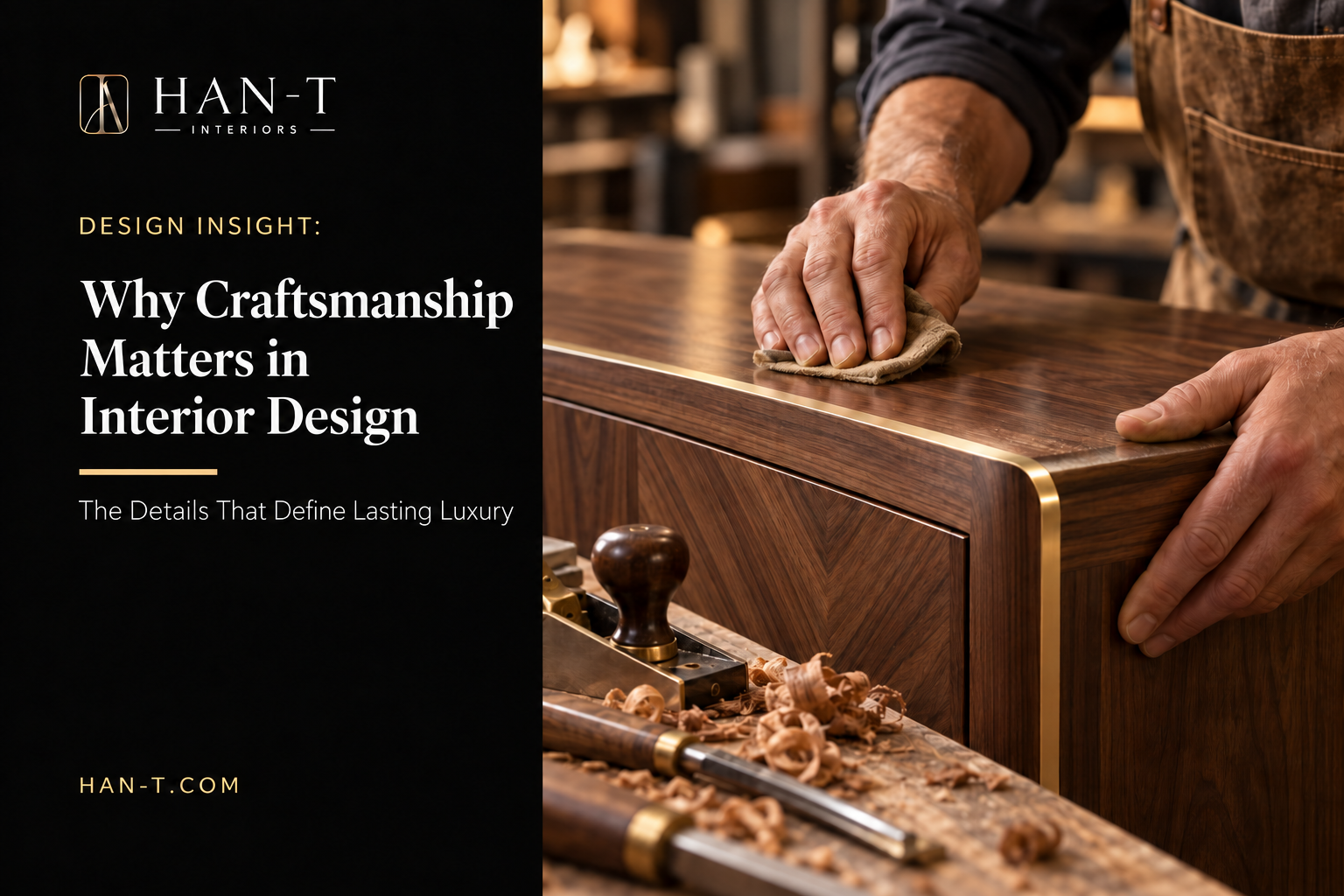
Craftsmanship is the point at which an interior design becomes real. Drawings can establish proportion, materials can provide beauty and technology can improve precision, but the finished space is ultimately judged through what people see, touch and use: the consistency of a shadow gap, the alignment of a door, the continuity of wood grain, the comfort of a seat and the way several materials meet at one corner.
In luxury interiors, these details are not secondary decoration. They are the visible evidence of planning, material knowledge, fabrication skill and disciplined installation. Good craftsmanship protects the design concept, improves durability and gives an interior the quiet sense of quality that cannot be created by expensive finishes alone. This guide explains why craftsmanship matters, where it becomes most visible and how clients and designers can evaluate it before a project is complete.
Craftsmanship at a glance
Craft dimension | What it controls | What the client experiences |
Precision | Alignment, tolerances, joints and movement | Doors close correctly and details feel calm and intentional. |
Material knowledge | Grain, finish, expansion, wear and repair | Surfaces age naturally instead of failing prematurely. |
Consistency | Repeated profiles, sheen, stitching and reveals | The whole project feels coherent rather than improvised. |
Problem solving | Site conditions, interfaces and hidden structure | Complex details work without visual compromise. |
Finishing | Edges, polishing, sanding, coating and touch | Materials feel refined at close range. |
Installation | Level, fit, protection and final adjustment | The designed quality survives delivery and site conditions. |
1 Craftsmanship turns design intent into physical reality
Interior design begins with an idea: a certain rhythm of panels, a clean transition from stone to timber, a floating cabinet or a curved upholstered wall. Craftsmanship determines whether that idea can be built without losing its proportion or elegance. A drawing may show a five-millimeter reveal, but production must account for the substrate, hardware, material thickness, edge construction, movement and installation tolerance required to keep that reveal consistent.
This translation is where experience matters. Skilled makers do not simply follow dimensions. They understand the purpose of the detail and choose a construction method that protects its visual effect. They can identify when a joint needs additional support, when a veneer sequence must change, when a radius is too tight for a finish or when access is required behind a seemingly seamless panel.
The strongest projects therefore connect design and making early. When fabricators review concepts before the drawings are frozen, difficult details can be tested, materials can be used efficiently and hidden technical problems can be solved before they become expensive site changes.
2 Precision creates the feeling of quality
People may not consciously measure the gaps around a cabinet door, but they notice when those gaps are uneven. They may not know the terminology for a poorly finished edge, yet they sense that the room feels less resolved. Perceived quality is built from hundreds of small relationships: parallel lines, centered hardware, repeated profiles, level surfaces and controlled transitions.
Precision is not the same as making every detail invisible. A joint can be expressed, a metal connection can become decorative and natural variation can remain visible. The important point is intention. The viewer should understand that the result was chosen and controlled rather than accepted by accident.
Tolerances also need to be realistic. Buildings are rarely perfectly square, natural materials vary and large components move during transport and installation. Good craftsmanship combines workshop accuracy with enough adjustment to achieve the intended result on site.
Conceptual visualization: skilled hand fitting protects alignment grain continuity and long term performance.
3 Material knowledge is part of the craft
Craftsmanship begins before cutting or assembly. Every material has a structure and a behavior. Timber responds to humidity, veneer has direction and sequence, stone contains natural variation, metal finishes react differently to touch, glass requires safe support and upholstery changes according to the foam, seam and tension beneath it.
A skilled team understands these conditions and designs with them. It does not force every material to behave like a uniform industrial sheet. Instead, it selects, sorts and positions each piece so natural character strengthens the composition. It also chooses appropriate substrates, adhesives, coatings, fasteners and movement provisions. Many failures that appear to be material problems are actually failures of specification or construction.
This knowledge is particularly important in luxury work because large surfaces and restrained palettes expose inconsistency. When a room depends on a few carefully chosen materials, poor grain selection, color variation or finish mismatch becomes immediately visible.
4 Woodwork reveals craftsmanship quickly
Custom cabinetry, wall paneling, doors and furniture require control at several scales. At a distance, the viewer reads proportion and rhythm. Closer, the grain sequence, joints, edges and hardware become visible. Finally, touch reveals the smoothness of the finish, the weight of a door and the quality of movement.
Good wood craftsmanship considers the cut and figure of the timber, veneer matching, substrate stability, edge treatment, sanding sequence, stain and protective coating. The grain should support the form. On a bank of tall doors, sequence matching can create a continuous architectural surface. On a smaller furniture piece, bookmatching or a contrasting solid edge may provide the right focus.
The internal construction matters as much as the visible face. Hardware must be supported, shelves must resist deflection and panels must remain stable. A beautifully veneered door that twists, rubs or loses alignment is not a successful luxury detail.
5 Metalwork depends on control of edges surfaces and connections
Metal introduces strength, fine profiles and visual contrast. It can form a structural frame, a delicate inlay, a handle or a decorative screen. Because light reveals every ripple and scratch, premium metalwork requires careful fabrication and finishing.
The craft includes clean cutting, accurate welding, controlled grinding, consistent brushing direction, polished edges and disciplined handling after finishing. A brass detail can be visually simple yet difficult to execute because the surrounding materials, adhesive lines and corner transitions must remain precise. If the design uses patinated or coated metal, the approval sample must establish color, sheen and acceptable variation.
6 Upholstery craftsmanship defines comfort
Upholstery is experienced through the body, so appearance alone is not enough. The internal frame, suspension, foam density, fiber wrap, pattern placement, seam position and fabric tension all influence comfort and longevity. Two sofas with similar silhouettes can feel completely different because of what is hidden beneath the surface.
Skilled upholsterers adjust construction to the textile and form. Thick bouclé, fine leather and patterned fabric cannot be handled in the same way. Curves require careful cutting and controlled tension; tailored edges need straight seams; removable covers need accurate allowances. On leather, hide selection and panel placement influence both appearance and aging.
7 The quality of a junction defines the whole room
Luxury interiors often combine timber, stone, metal, glass and textile within one fitted element. Each material may be excellent on its own, but the project succeeds or fails where they meet. A junction must accommodate thickness, edge strength, movement, fixing, cleaning and installation order while remaining visually controlled.
This is why details should be developed as assemblies rather than isolated finishes. The designer and fabricator need to agree where one material stops, which trade installs first, how the joint is protected, how it can be adjusted and whether future access is required. A shadow gap can create elegant separation, but it must be supported by a straight substrate and consistent depth. A metal inlay can sharpen an edge, but it must sit flush and remain repairable.
Conceptual visualization: luxury is often judged where different materials meet.
8 Technology supports craftsmanship but does not replace judgment
Digital modeling, CNC cutting, laser measurement and modern finishing systems have improved repeatability. They are especially valuable for complex curves, large panel sequences and components that must fit across several rooms. However, machines execute information; they do not automatically resolve incomplete details or understand the visual priority of a design.
Human judgment remains essential when selecting natural materials, adjusting color, refining an edge, balancing comfort and solving site variation. The most effective production combines digital accuracy with experienced hands. Technology manages repetition and precision, while craftspeople make the decisions that depend on touch, sight and context.
9 Shop drawings samples and mockups protect quality
Craftsmanship should be evaluated before the finished project. Detailed shop drawings translate design information into producible assemblies. They should show dimensions, material build-ups, grain direction, joint locations, hardware, lighting, access panels and interfaces with the building. Approvals should focus on both appearance and function.
Samples establish color, texture and sheen. Mockups go further by testing the relationship between materials and the practicality of construction. A full-size corner, door module or upholstered detail can reveal issues that are invisible in a rendering. It also provides a control standard for repeated production.
The approval process must be documented. Each sample should carry a product reference, finish code, date and approval status. Without a clear control sample, different teams may interpret words such as warm walnut, satin brass or soft ivory differently.
10 Installation is the final stage of craftsmanship
Factory quality can be lost during delivery or installation. Large bespoke pieces need secure packaging, clear labeling and an installation sequence that protects finished surfaces. Site teams must check dimensions, moisture conditions, levels, access and interfaces before fixing begins.
Professional installation includes adjustment and final inspection. Doors are aligned, hardware is tuned, joints are cleaned, protective films are removed at the correct time and minor finish defects are repaired. The team must also coordinate with lighting, stone, flooring and mechanical trades so one completed element is not damaged by another.
A final quality review should be performed from normal viewing positions as well as close range. Daylight and artificial light can reveal different problems. Functional tests should cover drawers, doors, integrated lighting, access panels and moving parts.
Conceptual visualization: careful installation and final adjustment preserve factory quality on site.
11 Craftsmanship improves durability and long term value
Good craftsmanship is not an aesthetic premium added after performance. It is one of the reasons an interior performs well. Correctly supported shelves remain level, sealed edges resist moisture, suitable joints accommodate movement and quality hardware continues to operate. Repairable construction also allows damaged components to be refinished or replaced without removing an entire installation.
The lowest initial price may become expensive when misalignment, finish failure or poor installation requires corrective work. In occupied homes, hotels and commercial spaces, replacement creates disruption as well as direct cost. Evaluating workmanship therefore means considering the total installed value and expected life of the interior, not only the quotation for materials and production.
12 How poor craftsmanship becomes visible
• Uneven shadow gaps or doors that do not align across one elevation.
• Wood grain that changes direction without a deliberate design reason.
• Visible adhesive lines, chipped edges or poorly resolved corners.
• Inconsistent metal color, brushing direction or weld finishing.
• Upholstery seams that wander, pull or distort around curves.
• Stone and joinery transitions that ignore material thickness or movement.
• Hardware that feels loose, noisy or difficult to operate.
• Site cuts and fillers that reveal insufficient measurement or planning.
A single imperfection may be repairable. Repeated inconsistency usually indicates a weak process: incomplete information, insufficient samples, poor communication, rushed production or inadequate site supervision.
13 How to evaluate a craftsmanship partner
What to review | What good evidence looks like | Warning sign |
Previous work | Close-up details and completed installations, not only wide renders | Only concept images or heavily retouched photographs |
Production capability | Relevant wood, metal, upholstery and finishing resources | Important work is outsourced without clear control |
Technical process | Shop drawings, samples, mockups and documented approvals | Production begins from concept drawings alone |
Quality control | Checks during production, before dispatch and after installation | Inspection happens only when the client reports a problem |
Installation | Experienced teams, protection plan and adjustment procedures | No clear responsibility after factory delivery |
Communication | One coordinated response across design, factory and site | Conflicting answers from separate trades |
14 The value of an integrated design and production process
When design, technical planning, production and installation are disconnected, responsibility can become unclear at the exact points where quality matters most. An integrated process reduces this risk. The team developing the detail can communicate directly with the people selecting materials, programming machinery, finishing surfaces and installing the final assembly.
HAN-T supports this continuity through specialized custom millwork and wood manufacturing, metal fabrication, upholstery, installation and logistics. For bespoke interiors, that coordination helps maintain the intended proportions, finishes and interfaces from the first drawing through final fitting.
Explore the HAN-T factory and production departments, learn how custom furniture is made, review guidance on material selection in luxury interiors, or contact HAN-T to discuss a residential, hospitality or commercial project.